
The first pulse can turn a light brown brow instantly black, and you should know that before you sit down
Cosmetic brow pigments are not tattoo ink. They commonly contain iron oxide and titanium dioxide, and a laser pulse can chemically reduce those to a darker compound. A soft brown brow can go grey, slate or black in the space of a second.
This is a known reaction, not an accident, and it is usually reversible with further sessions. But it is alarming if nobody warned you, and it is the reason a test spot comes before the brow.
Why brows behave differently from a body tattoo
| Body tattoo | Cosmetic brow | |
|---|---|---|
| What the pigment is | Carbon-based inks, largely predictable under a laser | Often iron and titanium oxides, which can darken instead of clearing |
| Where it sits | Thicker skin, away from the eye | Thin skin, millimetres from the eye, so internal eye shields are used |
| How it was applied | Deep and dense | Shallow and variable — microblading strokes, powder or older permanent makeup all behave differently |
| What "faded" means | Less ink | Not less pigment. A brow that drifted grey, blue or orange still has everything in it |
The test spot is the whole point
Before anything visible is treated, a small area at the tail of the brow is pulsed and then left alone. If the pigment darkens, we know before the rest of the brow does. If it lifts cleanly, the plan holds. Treating a full brow first and discovering the reaction afterwards leaves you wearing it while it is corrected.
The same logic governs everything else we do with pigment and light — the reasoning is set out at length in laser pigmentation on deeper skin, where the margin is narrow for a different reason.
How many sessions, honestly
- Microblading strokes, applied shallowly and already faded, often clear in fewer sessions than people expect.
- Dense powder or ombré brows, and older saturated permanent makeup, take more — sometimes many more.
- Sessions are spaced six to eight weeks apart. That gap is not scheduling convenience; it is how long the body takes to carry away what was broken up.
- Nobody can give you a session count from a photograph. What predicts it is what the pigment does in the test spot.
If you are removing it to have it redone
Say so at the consult, because the target changes. Removing to bare skin and removing enough that a new brow can be drawn over it are different endpoints, and the second is usually fewer sessions. Any new work waits until the skin has fully settled, and a reputable brow artist will ask how much pigment is still underneath before they start.
What we will not do
- Treat a full brow before a test spot has been done and looked at.
- Quote you a number of sessions from a photograph or a description.
- Work over a brow that is inflamed, infected, or was tattooed within the last two months.
- Promise removal to bare skin, which is not achievable for every pigment.
Where this is done
Eyebrow tattoo removal runs from the Downtown Montreal clinic only, since that is where the laser and the trained operators are. If you usually visit Laval, Saint-Léonard or Dollard-des-Ormeaux, this is the one treatment worth crossing town for.
See a doctor if
The brow area becomes increasingly painful, swollen, blistered or produces pus after a session, or you develop a fever. Also before treatment, if you have a history of keloid scarring or are taking medication that increases light sensitivity.
What we offer for this
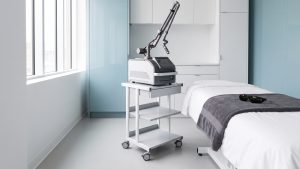 Eyebrow tattoo removal Downtown Montreal only. A test spot comes first, then the brow. 30 min · from $180 Small tattoo removal — 2x2 For a small mark elsewhere, priced by the area rather than the session. 30 min · from $110
 Free consultation Where the pigment gets looked at, before anyone quotes you a number of sessions. 15 min · no charge
Prices are a starting point and the consultation is free. What actually suits you is decided when we see the skin, not from a page.
Where to find us
Downtown Montreal — 2365 rue Saint-Patrick, Unit A5
Laval — 1655 boulevard de l'Avenir
Saint-Léonard — 5045 rue Jean-Talon Est
West Island — 45 boulevard Brunswick, Dollard-des-Ormeaux
This page is general information and is not medical advice. Laser treatment of cosmetic tattoo pigment can cause immediate darkening of the pigment, and complete removal is not achievable for every pigment. Increasing pain, swelling, blistering, pus or fever after a session needs prompt medical attention.
